
Mind Mapping: How to Organize Ideas Visually and Effectively

Mind Mapping has become an essential thinking technique for people seeking clarity, creativity, and structure in increasingly complex personal and professional environments.
Anúncios
In its essence, this approach transforms scattered thoughts into organized visual systems that mirror how the human brain naturally associates information.
Rather than forcing ideas into rigid outlines, mind maps encourage flexible connections that reveal patterns, priorities, and relationships often hidden in linear notes.
This article explores how visual thinking improves understanding, decision making, and memory by aligning organization methods with cognitive processes.
Through historical context, practical applications, and analytical insight, the text examines why mind mapping remains relevant in education, business, and creative work.
Anúncios
The central argument shows that mastering this visual method can significantly improve how individuals capture ideas, solve problems, and communicate complex concepts.
The Origins and Evolution of Visual Thinking
The foundations of visual thinking predate modern productivity methods, emerging from early diagrams, sketches, and symbolic representations used to explain abstract ideas and natural phenomena.
Ancient scholars used visual structures to map philosophical arguments, astronomical movements, and anatomical knowledge, recognizing that images could compress complex information into more understandable forms.
In the twentieth century, educational psychology reinforced these practices by demonstrating how associative learning improves retention and comprehension.
Tony Buzan later formalized mind mapping by combining neuroscience insights with practical note taking strategies designed to reflect how neurons form networks.
His work emphasized central ideas, branching concepts, and imagery as tools to stimulate creativity and long term memory simultaneously.
This evolution positioned mind mapping not as a trend, but as a synthesis of historical visualization practices and modern cognitive science.
++ The Science of Spaced Repetition: Learn Smarter, Not Harder
How the Brain Responds to Visual Organization
Cognitive research shows that the brain processes images faster than text, making visual structures powerful tools for understanding and recall.
Mind maps leverage this advantage by organizing information spatially, allowing users to see relationships instantly instead of decoding sequential sentences.
Neuroscientists explain that color, shape, and spatial hierarchy activate multiple neural pathways, strengthening memory consolidation.
According to research summarized by the American Psychological Association, visual learning techniques significantly enhance comprehension when integrated with active engagement.
This neurological response explains why mind mapping often feels intuitive, even for beginners encountering the method for the first time.
By aligning with natural cognitive tendencies, mind maps reduce mental overload while increasing clarity and focus.
Core Elements That Make Mind Maps Effective
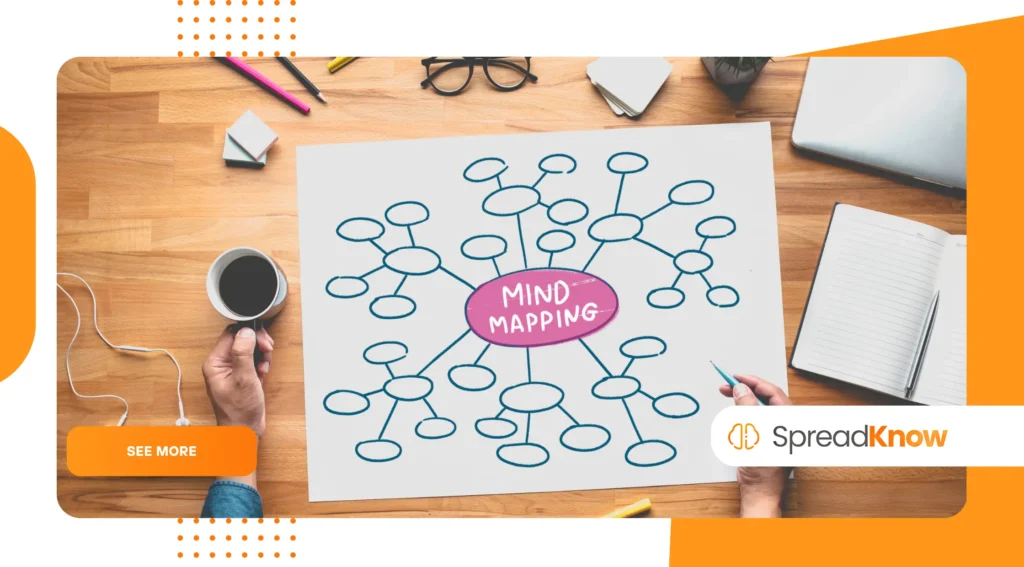
Every effective mind map begins with a central concept that anchors all related ideas within a single visual field.
From this core, branches radiate outward, representing major themes that divide naturally into subtopics and supporting details.
Keywords replace long sentences, forcing the creator to distill meaning rather than transcribe information passively.
Colors, icons, and images add emotional and contextual cues that make information easier to recall later.
The spatial arrangement allows ideas to grow organically, supporting nonlinear thinking without sacrificing overall structure.
Together, these elements create a flexible framework that adapts to brainstorming, planning, studying, or problem solving.
++ Why Sleep Is the Ultimate Study Tool
Practical Applications Across Different Fields
In education, students use mind mapping to summarize lectures, prepare essays, and connect concepts across disciplines more effectively.
Professionals rely on the method to plan projects, structure presentations, and clarify complex strategies during collaborative meetings.
Writers and creators use mind maps to explore narratives, themes, and character relationships before drafting linear content.
In corporate environments, visual planning tools support innovation workshops and strategic alignment across teams.
Business publications such as Harvard Business Review frequently highlight visual frameworks as catalysts for clearer thinking and better decision making.
These varied applications demonstrate that mind mapping adapts easily to different goals without losing effectiveness.
++ From Myths to Marvels: The Art of Visual Storytelling
Digital Versus Handwritten Mind Mapping
Handwritten mind maps offer tactile engagement that many users find beneficial for memory and concentration.
The physical act of drawing branches and symbols can slow thinking just enough to encourage deeper reflection.
Digital tools, however, provide scalability, easy editing, and collaboration features useful for complex or evolving projects.
Software platforms allow users to reorganize structures instantly without erasing or redrawing entire sections.
The choice between digital and analog methods depends on personal preference, context, and desired flexibility.
Both approaches preserve the core principles that make mind mapping valuable.
Common Mistakes and How to Avoid Them
One frequent mistake involves overcrowding a mind map with excessive text, which undermines its visual clarity.
Another issue arises when users create rigid, overly symmetrical structures that limit creative exploration.
Ignoring visual hierarchy can also confuse readers, making it difficult to identify main ideas quickly.
Effective maps require regular pruning, refinement, and thoughtful spacing to remain readable.
Users should revisit and revise their maps as understanding deepens or objectives change.
Mind mapping works best as an evolving process rather than a one time activity.
Comparing Mind Mapping With Linear Note Taking
Traditional linear notes follow a sequential logic that suits procedural information but struggles with complexity.
Mind maps, by contrast, present ideas simultaneously, allowing users to grasp overall structure at a glance.
The table below highlights key differences between these two approaches.
| Aspect | Mind Mapping | Linear Notes |
|---|---|---|
| Structure | Radial and associative | Sequential and hierarchical |
| Creativity | Encourages exploration | Limits idea expansion |
| Memory | Strong visual recall | Relies on repetition |
| Flexibility | Easily reorganized | Difficult to restructure |
| Engagement | Active participation | Often passive |
Understanding these differences helps individuals choose the most effective method for specific tasks.
Conclusion
Mind mapping offers more than a productivity technique, providing a cognitive framework aligned with how humans naturally process and organize information.
Its strength lies in combining structure with freedom, allowing clarity without suppressing creativity.
As information overload intensifies, visual organization becomes increasingly valuable for clear thinking and effective communication.
By adopting mind mapping thoughtfully, individuals can transform scattered ideas into meaningful, actionable insight.
FAQ
1. What is the main purpose of mind mapping?
The primary purpose of mind mapping is to organize ideas visually, helping individuals understand relationships, improve memory retention, and stimulate creative thinking through structured yet flexible diagrams.
2. Is mind mapping suitable for analytical tasks?
Mind mapping supports analytical work by revealing patterns, dependencies, and gaps, making it easier to evaluate complex problems holistically rather than processing isolated details sequentially.
3. Can mind maps replace traditional notes completely?
Mind maps can replace traditional notes for many tasks, although linear notes remain useful when precise sequences, formal documentation, or step by step instructions are required.
4. Do mind maps require artistic skill?
Artistic skill is unnecessary because effectiveness depends on clarity and structure, not aesthetic quality, allowing simple shapes and keywords to communicate ideas efficiently.
5. How long does it take to learn mind mapping effectively?
Most people grasp basic mind mapping quickly, but developing fluency and strategic use typically improves with consistent practice across different real world applications.