
How to Start Urban Sketching With Just a Notebook and a Pen
Urban sketching is rapidly transforming how creators capture the dynamic pulse of modern cityscapes without carrying cumbersome art supplies.
Anúncios
This practice empowers artists to document surrounding architecture, energetic streetscapes, and everyday human interactions using nothing more than a minimalist notebook and a reliable pen.
By stepping out of formal studios into public spaces, creators cultivate an intimate connection with local environments through direct observation.
This creative movement welcomes individuals of all technical backgrounds to cultivate mindful observation and artistic expression right where they live.
Key Navigation Highlights
- Understanding the Basics: Discovering the origins and core definition of location drawing.
- Essential Gear: Choosing the ultimate minimalist combination of paper and ink.
- Fundamental Techniques: Master line work, perspectives, and rapid observational skills.
- Practical Scenarios: Real-world examples comparing observational methodologies.
- Data Overview: Essential metrics and gear specs for modern field illustrators.
- Your Urban Roadmap: Step-by-step guidance to launch your journey smoothly today.
What Is Location Drawing and Why Is It Popular?
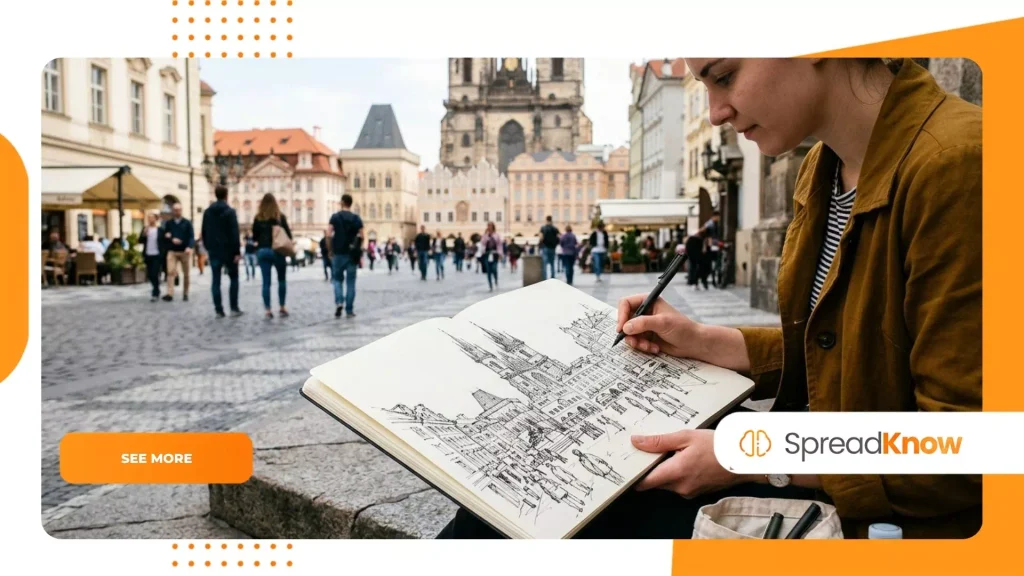
How Did This Global Visual Movement Begin?
The practice blossomed globally when Seattle-based journalist and illustrator Gabriel Campanario founded the international non-profit movement back in 2007.
Anúncios
He envisioned a worldwide community dedicated to drawing on-location, celebrating real scenes exactly as artists witness them unfold in real time.
Today, thousands of practitioners across hundreds of cities share their raw, unedited observational drawings daily, proving that artistic expression thrives without elaborate tools or artificial studio setups.
This expressive community adheres strictly to a foundational manifesto: showing the world one drawing at a time while staying entirely truthful to the surrounding scene.
By committing to drawing on location indoors or outdoors, participants preserve authentic historical moments, architectural evolutions, and cultural traditions.
Embracing urban sketching allows artists to build an invaluable visual diary of contemporary life, capturing fleeing seconds that photos often miss entirely.
What Makes Minimalist Field Sketching So Powerful?
Stripping away unnecessary artistic gear forces you to concentrate deeply on fundamental artistic values like form, contrast, perspective, and composition.
When you carry only a pocket notebook and a single pen, you completely eliminate setup friction, allowing immediate artistic action whenever inspiration strikes.
This radical simplicity transforms idle waiting times at bus stops, cafes, or public parks into highly productive, deeply relaxing sessions of focused artistic creation.
Practicing minimalist art serves as a powerful antidote to modern digital fatigue, acting much like an anchor that pulls you back into tactile reality.
According to a landmark study by the American Art Therapy Association, engaging in visual art creation for less than an hour significantly lowers cortisol levels in over 75% of participants regardless of prior skill.
By observing physical space rather than scrolling through digital displays, you develop a sharper eye for architectural geometry, shadow movements, and human gestures.
++ How Economic Sanctions Shape International Relations
How Do You Choose the Perfect Pen and Notebook?
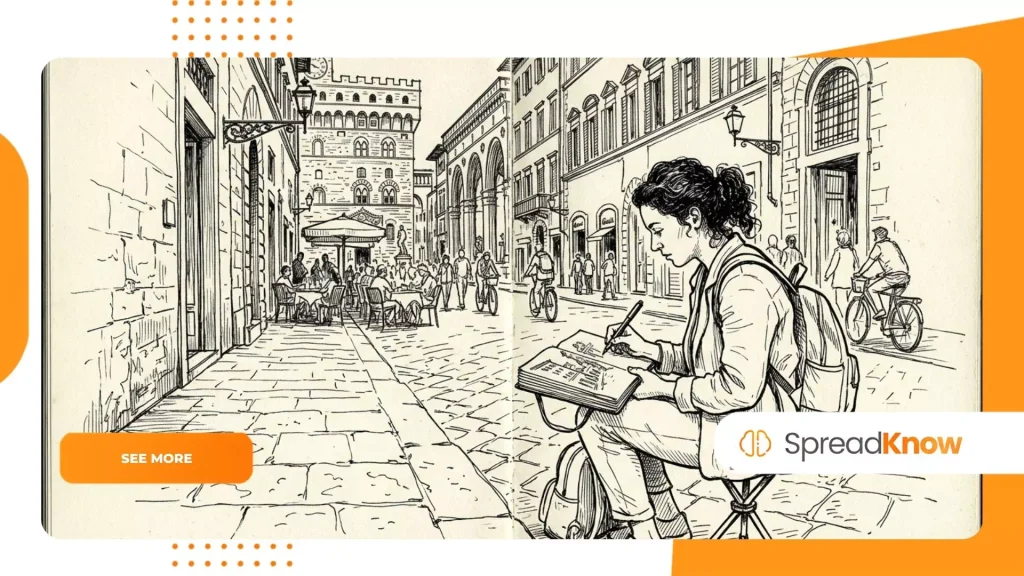
What Features Define an Ideal Urban Notebook?
Selecting paper for location work requires evaluating paper weight, binding durability, and overall physical size to ensure seamless portability everywhere.
You should look for paper rated around 140 to 180 GSM, which prevents ink bleed-through while remaining sturdy enough to handle subtle line layering.
Hardcover, thread-bound notebooks lying completely flat on your lap offer the robust physical support needed when drawing without a table or desk available.
Choosing pocket-friendly sizes like A5 or B6 allows maximum mobility without sacrificing essential drawing real estate during busy outdoor sessions.
Smooth tooth finishes allow fine pen tips to glide effortlessly without catching on paper fibers during rapid, spontaneous linework execution.
Equipping yourself with durable watercolor-friendly paper also leaves the door open for subtle wash additions if you decide to expand your toolset later down your creative path.
Also read: The Science Behind Skill Mastery Through Repetition
Which Pen Types Deliver the Best Results On-Location?
Fine-liner pens featuring archival waterproof pigment inks stand out as absolute essentials for location drawing because they resist accidental spills or moisture exposure.
Waterproof ink allows you to layer additional lines or wet washes later without muddying your original structural marks or losing crisp edges.
Meanwhile, fountain pens loaded with permanent ink offer dynamic line weight variations based entirely on hand pressure, stroke speed, and nib angles.
Ballpoint pens provide incredible versatility by allowing soft, faint shading through delicate pressure alongside dark, decisive contours under heavier pressure application.
Using waterproof fine-liners ensures your contour work stays permanently preserved regardless of sudden weather changes during long outdoors sessions.
Experimenting with various tip sizes from ultra-fine 0.1 mm nibs for intricate brickwork to 0.8 mm tips for bold foregrounds adds distinct visual depth to your page.
How Can Beginners Master Quick Field Techniques?
How Do You Handle Perspective and Scale in Public?
Mastering simple perspective begins by locating your eye-level horizon line across the page before placing any complex architectural features down.
Trace major vanishing angles using light, sweeping strokes to establish spatial depth, building a reliable geometric skeleton before filling in localized surface textures.
Remember that urban sketching prioritizes capturing the overall mood and energy of a scene over photorealistic geometric perfection or clinical drafting precision.
Establishing relative proportions prevents scenes from feeling distorted, so use your pen as an optical measuring tool against distant buildings.
Compare vertical heights against horizontal widths repeatedly to maintain structural accuracy throughout your rapid composition build-up phase.
Breaking complex structures down into basic geometric blocks cubes, cylinders, and triangles allows you to render daunting cathedrals or intricate bridges with absolute confidence and calm clarity.
Read more: Why Repetition Alone Doesn’t Work: Understanding Smart Practice
How Do You Capture Dynamic Human Movement Quickly?
Capturing moving people requires observing recurring postures rather than attempting to track a single individual who constantly shifts positions.
Look for repeating gestures, such as commuters waiting for traffic lights, baristas crafting drinks, or bench-bound readers absorbed in novels.
Draw the central spine curve and head position first, capturing body action instantly before adding secondary details like clothing folds, hairstyles, or footwear accessories.
Accepting impermanence remains the single most important mindset shift for capturing live human action within bustling city environments successfully.
If your subject walks away mid-stroke, simply shift your focus to another passerby occupying a similar pose to finish the figure organically.
Over time, your visual memory sharpens drastically, enabling you to retain complex body postures in your mind long after subjects vanish into crowded streets.
Practical Scenarios: Comparing On-Location Methodologies
Understanding how different environments dictate your technical approach keeps your field practice adaptable, spontaneous, and rewarding regardless of surrounding weather or crowds.
The table below outlines how minimalist tools perform across typical location scenarios.
| Location Setting | Primary Challenge | Recommended Gear Setup | Recommended Technique |
| Bustling Transit Hubs | Rapidly shifting subjects and high foot traffic | Pocket notebook & quick-drying 0.5 fine-liner | Continuous line drawing focusing on quick gesture silhouettes |
| Historic Architecture | Overwhelming structural detail and complex angles | Hardcover A5 sketchbook & waterproof fountain pen | Block-in basic geometric shapes before adding decorative trim |
| Quiet Outdoor Cafes | Changing light conditions and changing shadows | Medium-tooth notebook & versatile ballpoint pen | Layer pressure-sensitive shading to build depth and contrast |
| Public Parks | Organic foliage mixed with rigid urban structures | Cold-press sketchbook & dual-tip pigment pens | High-contrast contour lines paired with cross-hatch texturing |
What Common Pitfalls Should Novice Sketchers Avoid?
Why Should You Stop Over-Erasing and Start Embracing Mistakes?
Relying heavily on pencils and erasers creates cognitive hesitation, encouraging self-criticism before your creative ideas fully take shape on paper.
Committing directly to ink forces clear decision-making, converting accidental marks into charming character lines that highlight authentic human handiwork.
Isn’t raw, honest expression infinitely more fascinating than a polished, soulless copy of a photograph?
Embracing ink errors teaches critical problem-solving skills on the fly, showing you how to incorporate misplaced lines directly into background shading or architectural shadows.
This bold approach accelerates your technical growth significantly by rewarding quick spatial judgment over slow, fearful perfectionism.
Treating every single page as a low-stakes learning experiment removes the daunting fear of blank notebook pages forever.
How Do You Handle Working in Crowded Spaces Smoothly?
Working out in public inevitably attracts curious onlookers, which can make beginner artists feel overly self-conscious or anxious initially.
Positioning your back safely against walls, trees, or structural columns establishes a secure private boundary while keeping visual pathways clear.
Wearing headphones even without playing music signals polite focus to passersby, drastically minimizing conversational interruptions while you work peacefully.
Remind yourself that most public onlookers react with pure admiration and genuine curiosity rather than harsh judgment toward your ongoing artwork.
Sharing a brief, friendly smile easily diffuses tension, transforming potential awkwardness into brief, uplifting moments of community connection.
Over time, drawing amidst urban noise becomes a deeply immersive, meditative state that heightens focus rather than hindering technical execution.
Capturing Life Through Minimalist Ink
Adopting location drawing transforms ordinary daily routines into rich creative adventures, helping you rediscover hidden magic within familiar neighborhood streets.
Armed with merely a pocket sketchbook and a reliable ink pen, you possess everything required to record history, cultivate visual patience, and express your artistic voice.
Practicing urban sketching regularly sharpens your spatial awareness, turning everyday environments into endless sources of creative inspiration and personal discovery.
By committing to raw observation over rigid perfection, you build a unique visual library that reflects your authentic personal journey through time and space.
The streets are alive with story, color, texture, and character, just waiting for your ink line to bring them onto the page.
Grab your pen, open your notebook today, step outside, and capture the vibrant world unfolding right before your eyes and share your experience in the comments below!
Frequently Asked Questions
What is the single best pen for a complete beginner?
A waterproof 0.5 mm fine-liner or a medium-nib ballpoint pen is ideal for complete beginners. Fine-liners produce clean, dark lines instantly without smudging, while ballpoints offer incredible control over line weight through simple pressure variation.
How do I draw architecture without getting perspective wrong?
Focus on finding your eye-level line first and simplify complex structures into basic shapes like boxes and triangles.
Never worry about mathematical perfection; capturing the relative angles and general proportions accurately is more than enough to create believable buildings.
What should I do when people move before I finish drawing them?
Draw the main gesture line of the body instantly to lock in the posture. If the person walks away, wait for someone else to adopt a similar posture or use your visual memory to complete the remaining details naturally.
How can I get over the fear of drawing in public?
Start by drawing from inside quiet places like libraries, quiet cafes, or parked cars where foot traffic is minimal. As your confidence grows, move to public park benches, wearing headphones to create a comfortable personal boundary while you work.
How much time should I spend on a single field sketch?
Most quick field drawings take anywhere from 5 to 20 minutes to finish. Keeping your sessions brief prevents overthinking, helps maintain high visual energy, and fits seamlessly into busy daily routines without requiring dedicated hours of prep work.
