
The Cultural Impact of Street Art Beyond Aesthetics
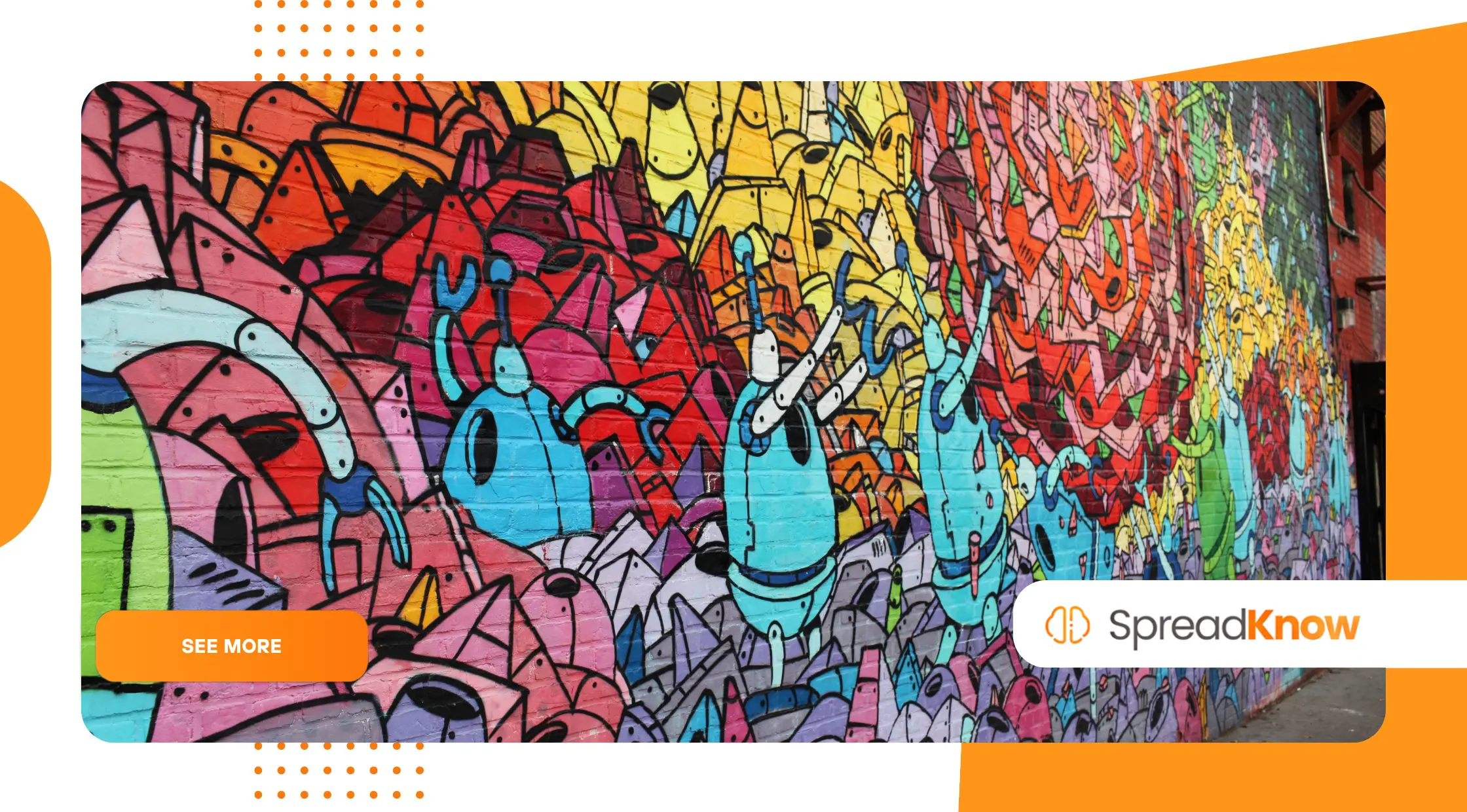
Street art has moved from the margins of criminal vandalism to the center of cultural conversation — and that journey reveals as much about how societies define legitimate expression as it does about the art itself.
Anuncios
What began as territorial marking and political protest in the train yards of New York and the walls of São Paulo has evolved into a global visual language spoken by practitioners from Buenos Aires to Beirut who use public space to say what galleries and institutions cannot or will not accommodate.
The cultural impact of street art extends well beyond the aesthetic dimension that critics and collectors most readily discuss — it operates simultaneously as social commentary, community reclamation, economic catalyst, and historical archive of the concerns that official culture preferred to ignore.
Banksy’s global recognition transformed the conversation about what street art could accomplish culturally, but it also created a misleading impression that the art form’s significance is primarily individual — when its deepest cultural effects operate collectively, at the level of neighborhoods and cities rather than individual practitioners.
UNESCO has recognized street art as a form of intangible cultural heritage in specific regional contexts, acknowledging that the visual traditions embedded in particular urban environments represent cultural knowledge that deserves documentation and consideration alongside more formally sanctioned art forms.
Anuncios
Understanding street art’s cultural impact requires moving beyond the surface debate about legality and aesthetics into the deeper questions about who gets to shape the visual environment of shared public space and whose stories that environment tells.
Street Art as Political Voice
The political function of street art is not incidental to its aesthetic dimension — it is constitutive of it, because the practice emerged and developed in contexts where the visual occupation of public space was itself a political act against environments designed to be seen rather than spoken back to.
The murals of the Irish Troubles documented a conflict that official media coverage systematically distorted — the Falls Road and Shankill Road murals created a visual record of competing community narratives that academic historians now treat as primary sources rather than mere decoration.
Diego Rivera’s murals in Mexico City and Detroit, commissioned by both the Mexican government and Henry Ford’s industry, demonstrated that scale and institutional support could amplify street art’s political function without domesticating it — Rivera embedded Marxist critique into the walls of capitalist institutions and government buildings with a directness that gallery work could never have sustained.
Contemporary political street art operates in a more complex environment where the line between authentic protest and sanitized aesthetic absorption is contested — a Banksy piece that begins as subversive commentary can become a tourist attraction within weeks, generating the kind of commercial attention that simultaneously validates and neutralizes the political charge.
The Arab Spring produced some of the most politically charged street art of the contemporary era — murals in Cairo, Tunis, and Beirut created visual records of revolutionary aspirations that were painted over by subsequent governments but documented digitally before erasure, demonstrating that street art’s political impact can survive its physical destruction.
The relationship between street art and political repression remains active — in multiple countries, murals have been classified as security threats, artists have been imprisoned, and governments have developed specific legal frameworks to criminalize visual political expression that occupies public space without permission.
++ Por qué la autoevaluación es la habilidad de estudio más subestimada
Community Identity and Neighborhood Reclamation
Street art’s most documented community impact is not its political content but its function in shaping how neighborhoods understand and represent themselves — a function that operates whether or not the art carries explicit political messaging.
The murals of Pilsen in Chicago, Wynwood in Miami, and Valparaíso in Chile transformed neglected urban areas into places that residents and visitors alike navigate partly through their visual landmarks — the murals became orientation points in the literal geographic sense alongside their cultural function.
Research on community mural programs consistently documents that collaborative production of neighborhood murals — where artists work with residents to develop imagery — produces stronger community identity outcomes than commissioned art placed without community participation, even when the commissioned work is aesthetically superior.
The Philadelphia Mural Arts Program, founded in 1984, has produced more than 4,000 murals across the city and represents the most extensively studied case of institutionalized community street art — with documented effects on neighborhood cohesion, youth engagement, and resident wellbeing that extend well beyond aesthetic improvement.
Gentrification complicates this picture significantly: the same murals that helped communities reclaim neglected spaces often become visual amenities that accelerate displacement — the cultural capital street art creates attracts investment that prices out the communities whose identity the art was created to represent.
The tension between street art as community reclamation and street art as gentrification catalyst is not resolvable through better intentions but requires structural policy responses that the art community alone cannot provide — making it a cultural impact that connects inevitably to questions of housing, economics, and political power.
The Art Market’s Absorption of Street Culture
The transition of street art from illegal practice to auction house commodity represents one of the most dramatic cultural absorptions in recent art history — and the consequences for the practice itself are contested among practitioners, critics, and communities.
Banksy’s works sell for tens of millions at Christie’s and Sotheby’s, Shepard Fairey’s Obama Hope poster became an American cultural icon, and Jean-Michel Basquiat’s paintings now command prices that place him among the most valuable artists in auction history — trajectories that would have been incomprehensible when these artists were working illegally on the streets of their cities.
The market absorption created opportunities that previous generations of street artists never had — income, institutional recognition, access to production resources — while simultaneously creating pressures toward the legibility, reproducibility, and collectibility that market logic rewards and that street art’s original illegibility explicitly rejected.
| Artista | Origen | Market Peak | Cultural Transformation |
|---|---|---|---|
| Banksy | Bristol street art | £16M at auction | Anonymous brand, global recognition |
| Basquiat | NYC subway graffiti | $110M at auction | Museum retrospectives, academic study |
| Shepard Fairey | Skate culture | National Museum collections | Political design mainstream |
| Os Gemeos | São Paulo graffiti | International commissions | Brazilian cultural ambassadors |
The commodification debate within street art communities reflects a genuine tension that has no clean resolution — artists who accept market absorption gain resources and audiences while risking loss of the confrontational relationship with public space that gave the work its original charge.
++ El papel del arte en los movimientos de resistencia política
Street Art as Urban Memory and Historical Archive
The archival function of street art — its capacity to record what official histories omit, commemorate what institutional memory ignores, and mark the presence of communities that dominant culture renders invisible — may be its most culturally durable contribution.
The murals painted in response to George Floyd’s death in 2020 created a distributed visual memorial that operated simultaneously in hundreds of cities, producing a geographic record of a collective cultural moment that no single institution could have commissioned or contained.
These murals were documented digitally before many were painted over or faded, creating a photographic archive of community response that historians will use to understand this period in ways that they will not be able to reconstruct from official sources alone.
Indigenous street art traditions in Australia, New Zealand, and across the Americas have used public walls to assert territorial and cultural claims that legal systems refused to recognize — creating a visual counter-record of land relationships and community presence that persists in public space regardless of official acknowledgment.
El Institución Smithsonian has formally incorporated street art documentation into its archival practices, recognizing that the ephemeral nature of the medium makes active preservation necessary and that the cultural record it contains cannot be recovered once the physical works are gone.
The ephemeral quality that distinguishes street art from gallery work — its vulnerability to weather, legal removal, and simple deterioration — gives the practice a relationship with time that permanent art cannot have, making each surviving piece a document of what its particular moment valued enough to save.
Global Diffusion and Local Adaptation
Street art has spread from its American and European origins into every region of the world, and the cultural impact of that diffusion is inseparable from how local contexts have transformed the practice rather than simply absorbed it.
Brazilian pixação — the angular, cryptographic tagging that covers São Paulo’s high-rise buildings — developed as a specifically local response to social exclusion, with a visual language so distinct from its American graffiti antecedents that researchers treat it as a separate cultural phenomenon rather than a local variant.
Japanese street art synthesizes graffiti culture with manga aesthetics and traditional motif systems in ways that produce work that is simultaneously globally legible and specifically Japanese — a cultural translation that operates in both directions, influencing the broader international street art community while remaining rooted in local visual traditions.
African street art scenes in Lagos, Nairobi, and Cape Town have developed distinct visual vocabularies that address local political conditions, historical legacies, and community concerns that imported American or European street art conventions could not have expressed with equivalent authenticity or cultural resonance.
The global diffusion of street art through social media — Instagram as the primary platform for building international audiences and sharing techniques across geographic boundaries — has created new pressures toward visual convergence that local practitioners navigate through deliberate choices about what to maintain and what to adapt from international influences.
++ Cómo los movimientos artísticos reflejan el espíritu de su tiempo
The Future of Street Art in Changing Urban Environments
The conditions that produced street art — abundant overlooked urban surfaces, concentrated young populations in dense cities, political urgency that official channels could not accommodate — are changing in ways that will reshape the practice without eliminating the impulse that drives it.
Digital augmented reality has already produced experiments in entirely virtual street art — works that exist only through smartphone viewing apps and that occupy public space without physical presence, eliminating the legal risk while also eliminating the material confrontation with the environment that gives physical street art its specific cultural charge.
The formalization of street art through legal mural programs, festival commissions, and architectural integration has created parallel tracks that some practitioners navigate simultaneously — illegal work that maintains the confrontational relationship with public space alongside legal commissions that provide income and reach.
The National Endowment for the Arts has funded public art initiatives that deliberately incorporate street art aesthetics and practitioners, representing an institutional acknowledgment that the cultural value produced by the tradition deserves public support even as it complicates the tradition’s relationship with authority.
The most culturally vital street art has always emerged from conditions of scarcity, urgency, and exclusion — and as long as those conditions persist in cities around the world, the impulse to mark public space with unauthorized visual statements will persist alongside whatever formal structures develop to accommodate it.
The cultural impact that matters most is not the work that ends up in auction houses but the work that remains on the walls of communities whose stories would otherwise go unrecorded — the murals, tags, and installations that make invisible lives visible in the shared visual environment of the city.
Conclusión
Street art’s cultural impact beyond aesthetics operates through political voice, community identity, market absorption, historical archiving, global adaptation, and the ongoing negotiation between institutional accommodation and the confrontational impulse that the practice has never fully surrendered.
The journey from criminal act to UNESCO recognition and auction house commodity reflects not a simple story of legitimization but a complex negotiation in which the cultural values embedded in street art have been simultaneously absorbed, neutralized, amplified, and transformed by the institutions that engage with it.
What persists through all of these transformations is the fundamental cultural proposition that street art embodies — that public space belongs to everyone who inhabits it, that visual expression of community experience is a legitimate claim on shared environments, and that the walls of cities are archives of what their residents actually lived through.
The next generation of practitioners will inherit both the tradition’s expanded legitimacy and its unresolved tensions — and the cultural choices they make in navigating those tensions will determine what street art contributes to the visual record of their own particular historical moment.
Preguntas frecuentes
1. How did street art transition from vandalism to cultural recognition? Through a combination of commercial market absorption beginning in the 1980s with artists like Basquiat, institutional recognition through museum exhibitions and public art programs, and the global visibility created by social media — each of which simultaneously validated and transformed the practice’s relationship with its outsider origins.
2. What is street art’s most significant cultural impact beyond aesthetics? Its archival function — the capacity to record community experiences, political moments, and cultural identities that official histories omit — may be the most durable. The murals documenting the Arab Spring, the George Floyd memorial art, and Indigenous territorial claims all represent cultural records that would otherwise not exist.
3. How does gentrification complicate street art’s community role? The cultural capital that street art creates in neglected neighborhoods attracts investment and development that often displaces the communities whose identity the art was created to represent — making street art simultaneously a tool of community reclamation and an inadvertent catalyst of the displacement it ostensibly opposes.
4. What distinguishes Brazilian pixação from other street art traditions? Pixação developed as a specifically local response to social exclusion in São Paulo, with a distinct angular visual language that addresses Brazilian class dynamics and urban conditions in ways that imported American graffiti conventions could not — making it a culturally specific phenomenon rather than a local variant of an international style.
5. How is digital technology changing street art’s future? Augmented reality experiments have produced entirely virtual street art that occupies public space without physical presence, eliminating legal risk while also eliminating the material confrontation with the environment that gives physical street art its specific cultural charge — creating a new tension between accessibility and the confrontational authenticity that defines the tradition.
